
Why Medicaid Enrollment Tracking Fails at Health Centers
Jan 1 Is Tomorrow
Last week I presented at NACHC CHI 2026 alongside Jason Wallace, CEO of New Horizon Health Center in Texas, Jenny Walden of the Indiana Primary Care Association, and Paula Tomko, CEO of Central Virginia Health Services. Different centers, different states, and I asked the packed room the same question: “By a show of hands, are you ready for what H.R.1 will bring?” A few hands went up but not enough in my opinion.
Then NACHC's CFO, Sean Roddy, said the line that's stuck with me since: "As far as I'm concerned, Jan 1 is tomorrow."
He's right. And you don't have to imagine what's coming. You already ran this experiment with the PHE Unwinding We were there and have the data below.
We've seen this movie before
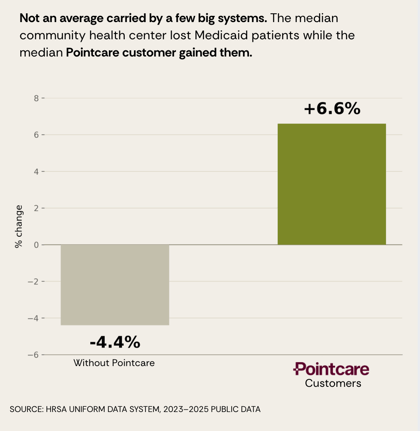
During the 2023–25 unwinding, the median health center in this country lost 4.4% of its Medicaid enrollment. Not the struggling ones. Not the outliers. The median.
If your center came through fine, ask yourself what that confidence is built on. Most centers that lost coverage didn't see it in their own numbers. They saw it in their revenue, months later.
Run the math on your own center. Take your annual reimbursement value per active Medicaid member. Multiply by 4.4%. That's not a hypothetical. That already happened once.
 .
. 
Why this isn't about eligibility
Here's what most people get wrong about redeterminations: it's not mostly about people becoming ineligible. Historically, up to 70% of redetermination losses are procedural. A missed form. A lapsed address. A work-requirement report filed a day late.
That happens to eligible patients. At every center. Regardless of your population's health status or income level.
Starting late 2026, redeterminations move from once a year to twice a year. That doesn't just add volume. It doubles the number of chances for a paperwork failure to hit your members.
The gap already exists
Here's the part that should change how you think about "wait and see."
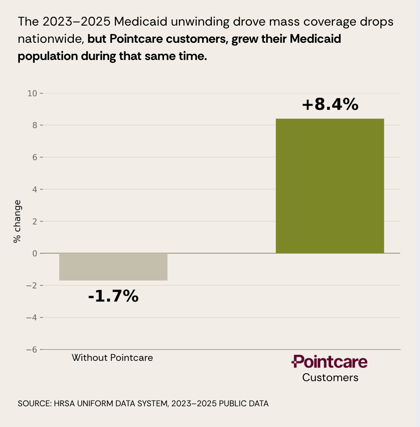
Under the old rules, centers with a Pointcare in place grew Medicaid enrollment a median of 6.6%, over the same two years the field lost 4.4%. That's an 11-point swing. That gap is already visible in your peers' HRSA filings, whether or not you're tracking it on your own.
And that gap was built under the easier rules. It's about to be tested under a much harder set with HR1.
Waiting isn't the safe move
"Wait and see" only works if you'll actually see it in time to act. The unwinding data says you won't. Centers didn't catch the loss until it was already behind them.
Twice-yearly redeterminations cut your runway in half. React after you see the drop, and you're not managing one bad cycle. You're managing six months of compounding losses, twice a year, forever.
The conservative move here isn't patience. It's monitoring before the volume doubles.
You've already seen what happens without it. Jan 1 is tomorrow. I urge you to prepare accordingly.
Everett Lebherz
Co-Founder and CEO of Pointcare.
P.S. Ready to chat?